Every time Netflix suggests a show you end up loving, your email filters out a scam, or your phone unlocks when it sees your face, machine learning is doing the work. It powers much of the technology we use every day, but for many people it still feels like a black box. This article explains what machine learning is, how it works, and why it matters.
What Is Machine Learning?
Machine learning (ML) is a branch of artificial intelligence that lets computers learn patterns from data and make decisions or predictions without being explicitly programmed for every situation.
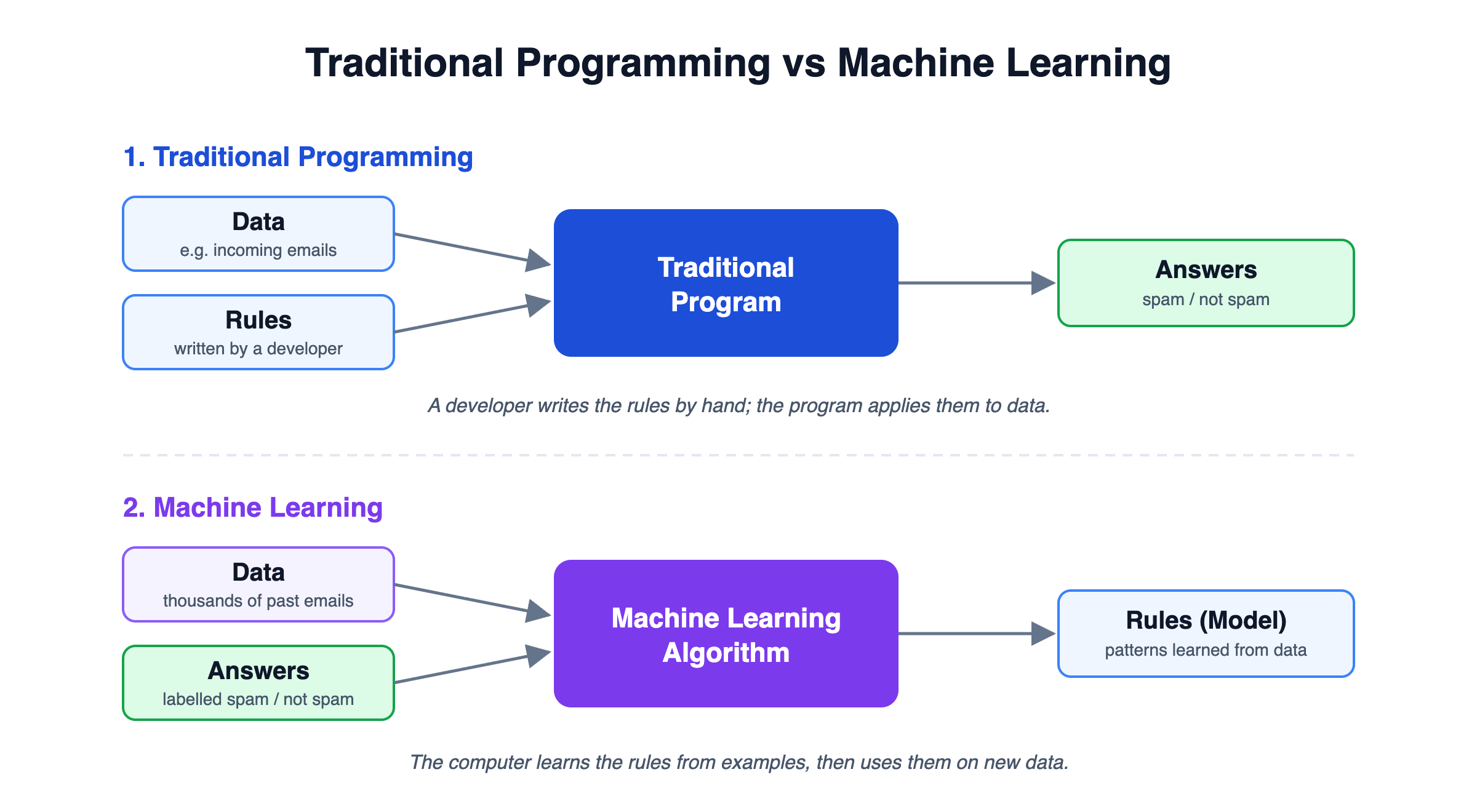
In traditional programming, a developer writes rules: if X happens, do Y. That works well for clearly defined problems, but it breaks down when the rules are too complex to write by hand. Try writing rules to recognise a cat in a photo. You’d have to cover every breed, angle, lighting condition and pose.
Machine learning flips the approach. Instead of writing the rules, we give the computer thousands of labelled examples (“this is a cat”, “this is not a cat”) and let it work out the patterns itself.
Traditional programming: Data + Rules → Answers
Machine learning: Data + Answers → Rules
A Simple Analogy
Think about how a child learns to recognise a dog. Nobody hands them a technical definition. They see many dogs over time, big and small, fluffy and short-haired, and their brain gradually builds an idea of what a dog is. Eventually they can recognise a breed they’ve never seen before.
Machine learning works in a similar way. The more good-quality examples a model sees, the better it gets at spotting patterns and handling new situations.
How Machine Learning Works
Most ML projects follow the same basic steps:
- Collect data. Gather relevant examples, such as past sales records, images, customer reviews or sensor readings.
- Prepare the data. Clean it, remove errors, handle missing values and put it into a usable format. This step often takes the most time.
- Choose a model. Pick an algorithm suited to the problem, such as a decision tree, linear regression or neural network.
- Train the model. Feed the data to the algorithm so it can learn patterns. The model adjusts its internal parameters to reduce its errors.
- Evaluate. Test the model on data it hasn’t seen to check how well it generalises.
- Deploy and improve. Put the model into a real application, monitor how it performs, and retrain it as new data comes in.
The Three Main Types of Machine Learning
1. Supervised Learning
The model learns from labelled data, where every example comes with the correct answer.
- Example: Predicting house prices from features like size, location and number of rooms, using historical sales data.
- Common uses: Spam detection, credit scoring, medical image classification, sales forecasting.
2. Unsupervised Learning
The model gets unlabelled data and has to find hidden structures or groupings by itself.
- Example: Grouping customers into segments by purchasing behaviour without defining the segments in advance.
- Common uses: Customer segmentation, anomaly detection, recommendation systems.
3. Reinforcement Learning
The model learns by trial and error. It interacts with an environment and receives rewards or penalties for its actions.
- Example: An AI learning to play chess by playing millions of games and gradually learning which moves lead to wins.
- Common uses: Robotics, game-playing AI, autonomous driving, resource optimisation.
Real-World Applications
Machine learning is already built into almost every industry:
- Healthcare: Detecting diseases in X-rays and scans, predicting patient risk.
- Finance: Fraud detection, algorithmic trading, loan approvals.
- Retail & E-commerce: Product recommendations, demand forecasting, dynamic pricing.
- Transportation: Route optimisation, ride-sharing demand prediction, self-driving systems.
- Customer Service: Chatbots and virtual assistants that understand and answer queries.
- Manufacturing: Predictive maintenance that spots equipment failures before they happen.
Machine Learning vs AI vs Deep Learning
These terms are often used interchangeably, but they mean different things:
- Artificial Intelligence (AI) is the broad goal of building machines that can perform tasks that normally need human intelligence.
- Machine Learning (ML) is a subset of AI focused on systems that learn from data.
- Deep Learning (DL) is a subset of ML that uses multi-layered neural networks, loosely inspired by the human brain. It powers image recognition, speech recognition and large language models.
Think of them as nested circles: deep learning sits inside machine learning, which sits inside AI.
Challenges to Keep in Mind
Machine learning is powerful, but it isn’t magic:
- Data quality matters. A model is only as good as the data it learns from: garbage in, garbage out.
- Bias. If the training data reflects historical biases, the model can repeat or even amplify them.
- Explainability. Some models, especially deep neural networks, make it hard to see why they reached a decision.
- Overfitting. A model can memorise its training data instead of learning general patterns, so it performs poorly on new data.
Basic Math Skills for Machine Learning
You don’t need to be a mathematician to start with machine learning. Libraries like scikit-learn and PyTorch do the heavy calculations for you. But a basic grasp of the maths helps you understand why a model behaves the way it does, choose the right approach, and fix problems when results look wrong. These are the four areas that matter most.
1. Linear Algebra: The Language of Data
In ML, data is stored as numbers arranged in vectors (lists of numbers) and matrices (tables of numbers). A single customer might be a vector like [age, income, number of purchases], and a whole dataset is a matrix where each row is one customer.
- Key concepts: vectors, matrices, matrix multiplication, dot products.
- Where it’s used: Representing data, images (a grid of pixel values) and text embeddings; every layer of a neural network is essentially a matrix multiplication.
2. Calculus: How Models Learn
Training a model means reducing its errors step by step. Calculus, and specifically derivatives, tells the model which direction to adjust its parameters to make the error smaller. This process is called gradient descent.
Think of it like walking down a hill blindfolded: you feel the slope under your feet (the derivative) and take a small step downhill, again and again, until you reach the bottom (the lowest error).
- Key concepts: derivatives, partial derivatives, gradients, the chain rule.
- Where it’s used: Gradient descent and backpropagation, the method neural networks use to learn.
3. Probability: Dealing with Uncertainty
Real-world data is messy and predictions are rarely 100% certain. Probability helps models express how confident they are, for example “there is a 92% chance this email is spam.”
- Key concepts: probability basics, conditional probability, Bayes’ theorem, probability distributions (such as the normal distribution).
- Where it’s used: Classification models, spam filters (Naive Bayes), risk scoring, and language models predicting the next word.
4. Statistics: Understanding and Evaluating Data
Statistics helps you understand your data before training and judge your model after training.
- Key concepts: mean, median, variance, standard deviation, correlation, sampling, hypothesis testing.
- Where it’s used: Exploring and cleaning data, spotting outliers, and measuring model performance with metrics like accuracy, precision and recall.
A Simple Example: Linear Regression
One of the simplest ML models brings these ideas together. Suppose we want to predict a house price from its size. The model learns a straight line:
price = w × size + b
Here w (weight) and b (bias) are the values the model learns. It starts with random values, measures how far its predictions are from the real prices (statistics), uses derivatives to decide how to adjust w and b (calculus), and repeats until the error is as small as possible. With many features, the same idea is written using vectors and matrices (linear algebra).
Quick Reference
| Math area | What it helps with | Start by learning |
|---|---|---|
| Linear Algebra | Representing and transforming data | Vectors, matrices, dot product |
| Calculus | Training and optimising models | Derivatives, gradient descent |
| Probability | Making predictions under uncertainty | Conditional probability, Bayes’ theorem |
| Statistics | Understanding data and evaluating models | Mean, variance, distributions |
Tip: Don’t wait until you’ve mastered all the maths before you start building. Learn the basics, start experimenting with code, and go deeper into each topic as your projects need it.
Getting Started with Machine Learning
If you’re curious to explore ML yourself:
- Learn Python. It’s the most widely used language for ML.
- Explore key libraries such as scikit-learn (classic ML), pandas (data handling), and TensorFlow or PyTorch (deep learning).
- Practise with real datasets on platforms like Kaggle.
- Start small. Build a simple model, like predicting house prices or classifying flowers, before moving on to complex projects.
Conclusion
Machine learning is changing how businesses operate and how people interact with technology. At its core, the idea is simple: teach computers to learn from experience. As data keeps growing and computing power keeps getting cheaper, ML will only become more central to innovation in every field.
Whether you’re a business leader looking for automation opportunities or a developer starting your AI journey, understanding the basics of machine learning is the first step.
At SciAiLabs, we help businesses use AI, machine learning and agentic automation to solve real-world problems. Get in touch to find out how ML can work for you.